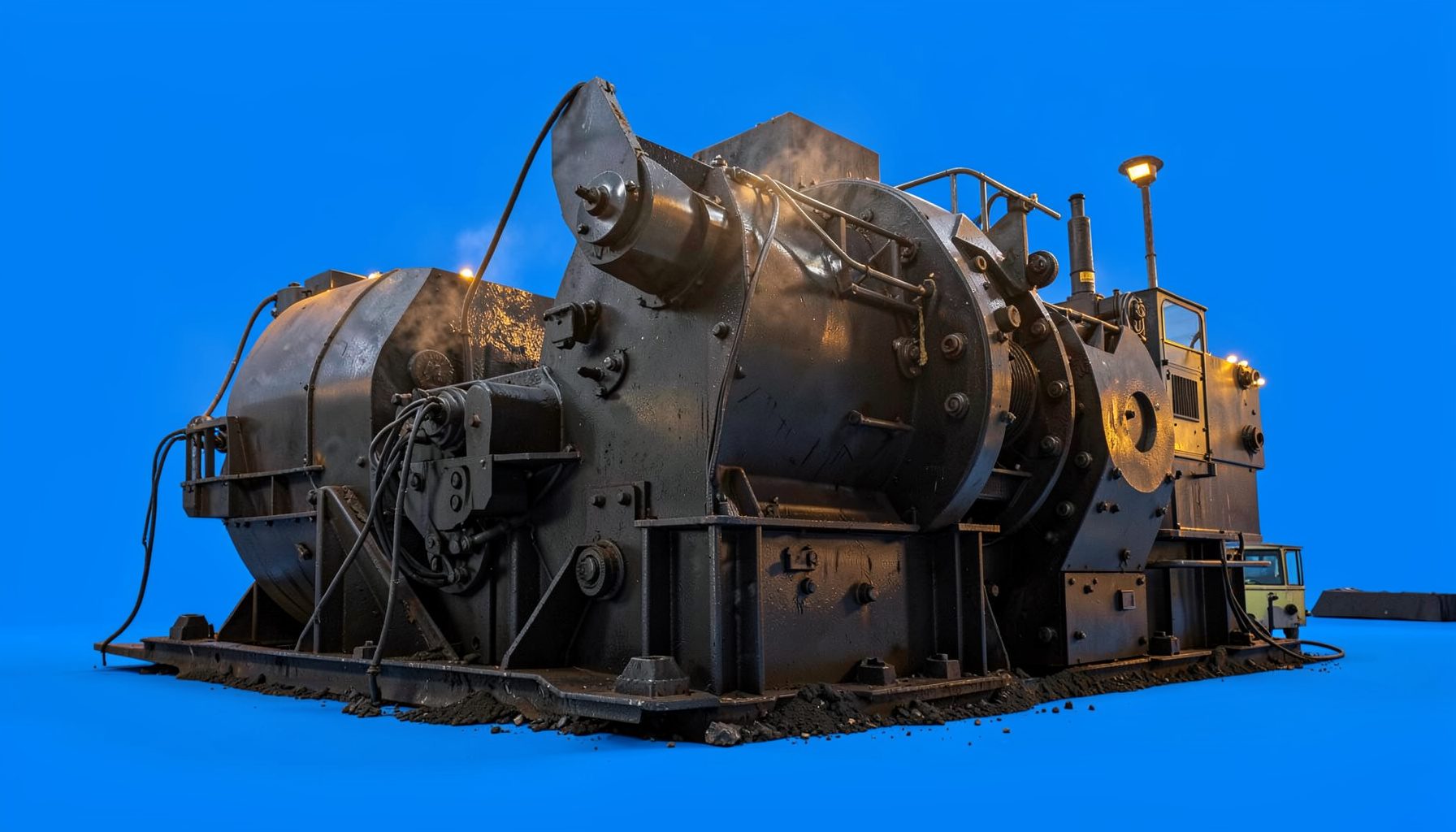
Why Bearing Temperature Monitoring Protects Large Grinding Mills
Large grinding mills convert hard rock, ore and recycled aggregates into material fine enough for downstream processing. Within them, large grinding mill bearings support heavy rotating loads and must maintain a thin, dependable film of lubricant between rolling elements and races. When that film fails, heat builds quickly, making bearing temperature one of the earliest indicators that something has changed inside the mill. A gradual rise can expose developing trouble days before seizure, liner damage or a production stop.
Shanghai CME Mining and Construction Machinery Co., Ltd. manufactures grinding and mineral-processing equipment, including vertical mills and trapezium mills for quarry, cement, mining and aggregate operations. Its crusher, screening, washing, conveying and mobile-plant portfolio is sold internationally. For Australian sites, where heat, dust, long travel distances and imported spare-part lead times are everyday realities, temperature monitoring is both a maintenance control and a production-planning tool.
Heat as an Early Warning Signal
Bearing heat is generated by friction and internal losses, and a properly loaded bearing should reach a repeatable operating temperature. Useful monitoring therefore means more than displaying a number. It means comparing that number with the mill’s normal range at the same feed rate, power draw, speed, lubricant condition and ambient temperature. A bearing that rises from 55°C to 65°C may still be acceptable if every load-matched baseline is similar, while 65°C could be serious on a machine whose bearings normally settle near 45°C.
Several faults can create the same visible symptom. Restricted oil passages, failed pumps, incorrect lubricant viscosity, excessive grease, blocked filters and water-contaminated oil all alter lubrication. Hard or unexpected feed, a plugged mill, liner damage, shaft misalignment or excessive preload can raise load and heat. Failed seals and ingress of abrasive dust can damage surfaces, causing the temperature pattern to become less even across the drive-end and non-drive-end bearings.
Continued operation turns a warning into damage. Excess heat degrades oil, softens or burns seals, reduces viscosity and changes bearing clearance. Metal transfer can then damage races and rolling elements, while thermal expansion may disturb alignment. The value of monitoring is not that it proves the cause by itself; it gives maintenance staff time to stop or reduce load, protect the asset and confirm the cause with supporting checks.
Turning Temperature Trends into Useful Diagnosis
A single alarm snapshot is less valuable than a trend. Record absolute metal temperature, rate of rise and differences between comparable bearings. Establish baselines during steady production at several load levels, then include ambient temperature so a hot day is not mistaken for mechanical deterioration. Trends should survive after a power interruption, and every alarm should carry a timestamp, the operating load and the sensor identity.
Temperature should be checked against lubrication and mechanical evidence. For oil-lubricated mills, monitor pressure, flow, return temperature and filter differential pressure; for grease systems, track relubrication cycles, grease quantity and pressure. Vibration, acoustic noise, motor current, mill power and visible oil conditions help distinguish overload from poor lubrication. An unusually cool bearing under heavy load can also indicate inadequate flow, so “normal” readings deserve investigation when other signals disagree.
Alarm limits must come from the equipment manual and verified site data, not a generic rule copied between machines. Staged alerts can flag a slow rise, an abnormal differential or a rate-of-change event before a high-temperature trip is reached. Delays and hysteresis reduce nuisance shutdowns during feed surges, while an independent hard-wired safety loop remains valuable where fitted. This combination supports practical decisions without turning ordinary operating variation into an emergency.
Australian Site Conditions and Supply Realities
Australia adds conditions that make careful baselines essential. In the Pilbara, summer ambient temperatures can exceed 40°C, while a mill’s housing and foundation may heat faster than the air. At remote operations around Kalgoorlie, replacement components and technicians can take days to arrive, so an early thermal warning can prevent a much longer outage. Overnight temperature swings also change lubricant viscosity and can reveal a lubrication problem that was hidden during a warmer shift.
Imported equipment must also be planned into the maintenance system. Machinery and spare sensors may clear through Australian Border Force at hubs such as Perth’s Fremantle or Melbourne’s Port Botany, with classification, duties, taxes, brokerage and delivery forming part of the landed cost. Buyers should confirm electrical compatibility, Australian certification where applicable and local technician support before shipment. Critical transmitters, probes and communication modules should be identified well before a failure, rather than ordered after a mill has stopped.
The local market includes large aggregate producers around Melbourne, Sydney and Brisbane, as well as mining and cement plants. Screening and washing generate fines and surplus water that must be managed without creating unstable piles or recirculating contaminants. The advice on aggregate stockpiling practices explains how good separation, drainage and stockpile geometry can reduce moisture migration and clean-up work. These controls do not replace bearing protection, but they reduce housekeeping loads and prevent wet material from compromising adjacent plant.
Designing a Reliable Monitoring System
For continuous protection, fixed RTD or thermocouple probes are commonly mounted at bearing housings, with sensor positions and insertion depth specified by the mill builder. Important locations include both ends of the main bearing and the bearings most exposed to the load zone. Installations need secure thermal contact, correct polarity, suitable cable glands and calibration records. Measuring only lubricant temperature or ambient air can miss the local hot spot the operator needs to see.
Wireless temperature transmitters can simplify large sites with many conveyors, motors and mills, provided the radio path, dust protection, power supply and network security have been tested. Gateways should store readings locally if cloud access is interrupted, and critical alarms need a route that works when the main network does not. Portable infrared cameras are useful for routine surveys, but polished or painted housings, viewing angle, distance and emissivity settings affect accuracy. They complement fixed probes rather than replacing trendable measurements.
Where the control package also includes wash-water quality signals, engineers should verify signal units before comparing trends. A short guide to convert turbidity units explains the relationship between nephelometric readings and formazin-based units, helping prevent a display-scale change from being interpreted as a process change. On Australian sites, the operating procedure should also identify authorised access, isolation steps and escalation contacts under Safe Work Australia principles and applicable state workplace requirements.
Maintenance and Spare Parts Strategy
A useful maintenance routine turns thermal data into action. During each shift, operators can compare drive-end and non-drive-end readings with the previous run; during planned stops, technicians inspect seals, oil condition, grease points, foundation bolts, alignment and nearby piping. Any sharp rise requires a controlled load reduction and investigation, not repeated resetting of the alarm. Lockout, isolation and heat-safe work procedures must be applied before guards are opened or lubricants are sampled.
Spare-parts planning should cover more than the bearing itself. Stock compatible probes, extension leads, glands, transmitters, power supplies, memory modules and seals, and record firmware, calibration settings and wiring diagrams for each position. Consumable items such as filters, seals and specified lubricant should be managed according to condition and shelf-life requirements. Shanghai CME can support equipment selection, replacement identification and the matching of mill components, reducing uncertainty when a failed sensor must be replaced quickly.
Mobile installations need the same discipline. On mobile crushing plants, repeated road transport, vibration, changing feed and long idle periods can complicate comparisons with a fixed mill. Temperature checks should occur after the machine reaches a stable operating state, while loggers preserve peaks during travel and shutdowns. Hot bearings, damaged guards or leaking lubricants should be assessed before the plant moves again, because a transport-related fault can be carried into the next quarry campaign.
Comparing Monitoring Methods
Each monitoring method has a different balance of detail, cost and convenience. Fixed sensors suit continuous machine protection; portable scans suit scheduled diagnostics; vibration analysis reveals mechanical symptoms that temperature alone may not show. The best choice depends on bearing design, how critical the mill is, available staff, network infrastructure and the consequence of downtime.
For a new large mill, specify sensor locations, alarm architecture, data retention and interface requirements during procurement rather than after commissioning. For an operating mill, begin with the most accessible bearing housings, validate measurements against manual readings and build a reliable baseline before expanding coverage. Portable cameras should then be used to identify inconsistent zones, with findings checked against fixed readings and operating records.
| Method | Best suited to | Main strength | Practical limitation |
|---|---|---|---|
| Fixed wired probes | Continuous protection and automatic alarms | Stable, repeatable trends and fast control response | Installation, cabling and sensor maintenance |
| Wireless transmitters | Large or remote plants with many monitored points | Faster deployment and easier expansion | Battery life, radio coverage and network security |
| Portable infrared surveys | Periodic scans of many housings | Quick visual ranking of hot areas | Emissivity, angle and spot-check limitations |
| Vibration analysis | Detecting rolling-element or gear-mesh faults | Reveals mechanical faults before a thermal peak | Specialist setup and interpretation |
| Integrated condition monitoring | Multi-variable plant oversight | Centralised trends, alarms and reports | Higher cost and integration effort |
A layered scheme is usually more dependable than reliance on one instrument. Fixed temperature probes provide the continuous baseline, portable thermal imaging verifies physical conditions, and vibration and lubrication data explain why a bearing is changing. When those signals are calibrated, logged and reviewed through a defined response process, temperature monitoring becomes an early-warning system that protects bearings, reduces emergency replacement and supports dependable output from large grinding circuits.