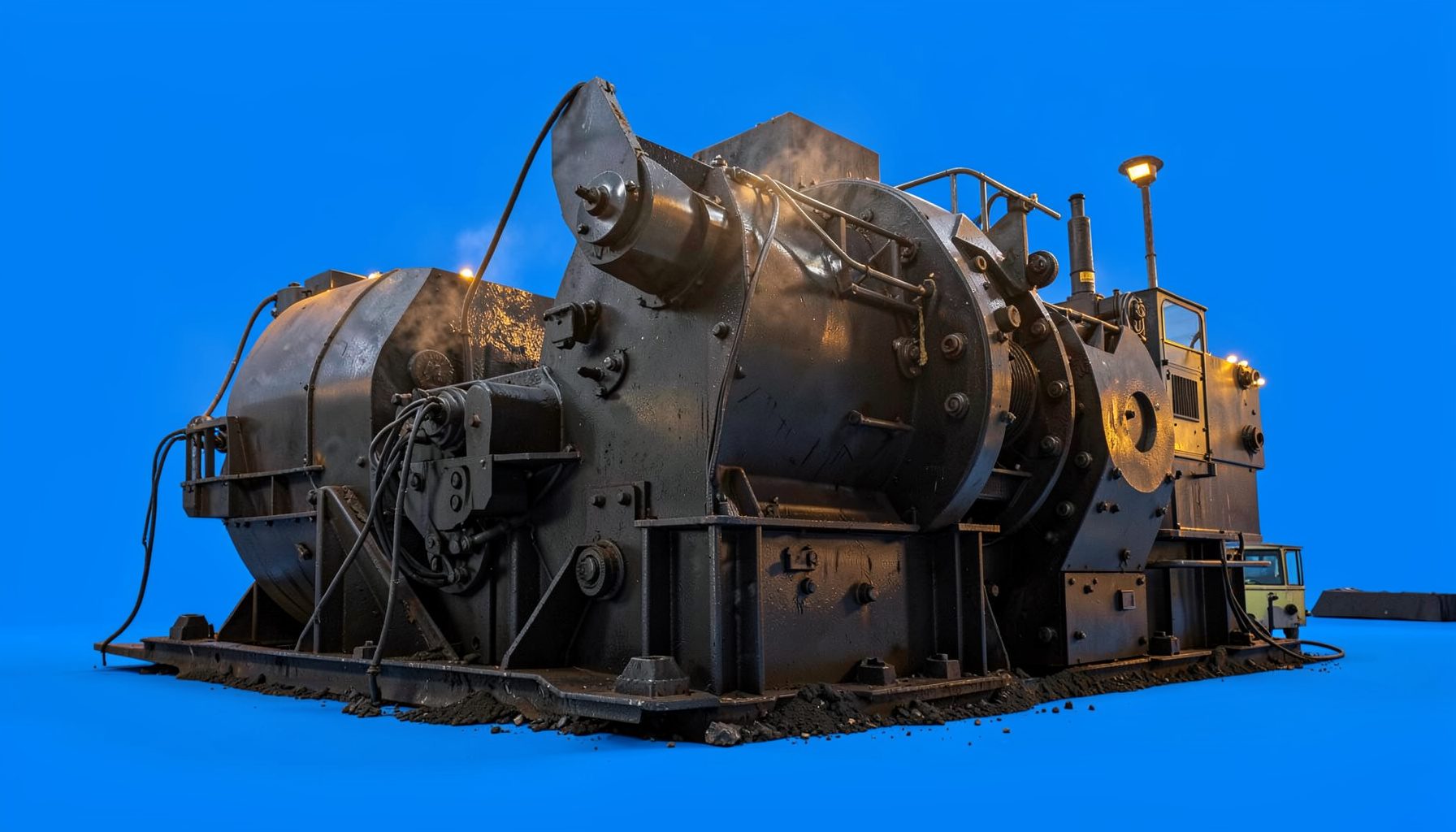
Trapezium mill power calculation for moisture-laden feed
A trapezium mill, also called a vertical roller mill, reduces feed between rotating rollers and a grinding table. Its required power follows from dry-solids throughput, the energy needed to reach the target product size and the efficiency of the drive train. Feed moisture changes that relationship because water adds transport mass and can alter grindability. A sound calculation separates wet feed from dry solids and uses energy data obtained at representative moisture, rather than applying a single kW-per-tonne rule.
This method suits Australian quarry and mineral-processing operations, from aggregate plants around Bathurst, Orange and Lithgow to mineral projects near Parkes. Operators commonly discuss mill feed in tonnes per hour and describe product by its top-size gradation in millimetres, so the calculation should finish in kW for the mill motor, with feeder, classifier and water-handling duties identified separately. The aim is reliable capacity at the wettest expected operating condition without paying for unnecessary installed power.
| Feed condition | Indicative wet-basis moisture | Effect on mill handling | Power treatment |
|---|---|---|---|
| Dry to low | Usually below 5% | Dust control and roller loading become important | Use site-specific dry-feed energy data and allow for dust extraction |
| Moderately moist | Often around 5–10% | Lubrication may reduce energy use while material starts to stick | Apply tested wet-grinding energy and check feeder capacity |
| Very wet | Often above 10% | Sliding, coating, poor classification and roller build-up become more likely | Treat it as a special duty and obtain mill-specific test data |
Start with the actual moisture basis
Measure moisture on representative mill feed, not on a water sample from the stockpile. Express it on a wet basis: w = Mwater / Mwet, where both masses use the same units and w is a decimal. If a belt scale reports 100 t/h and the moisture analyser reports 8%, the water portion is 8 t/h, not an extra 8% of dry tonnes. Keep the moisture basis beside every flow figure.
Moisture bands are only screening guides. Clay, limestone, slag and hard ore can tolerate, and react to, different water contents; the ranges above are not equipment limits. Broader vertical mill information can help with mill terminology, but the plant material remains decisive. In northern Queensland, summer rain and cyclone-era stockpiling can change feed moisture quickly, making a dry-season calculation poor evidence of wet-season capacity.
Sample across the feed stream and over a full production cycle, including reclaimed material from the stockpile. Surface moisture affects handling; total moisture is needed for the mass balance. Calibrate probes against laboratory or oven-dry checks using a validated procedure, because a small bias at 8% becomes a large dry-solids error at high throughput. Repeat the test when the ore, blend or source changes.
Convert wet feed to dry solids
Use the wet-basis moisture to remove water from the production rate: Fdry = Fwet / (1 + w). At 100 t/h of wet feed and 8% moisture, Fdry = 100 / 1.08 = 92.6 t/h, leaving 7.4 t/h of water. Rounding must follow the precision of the measurements; 92 t/h may be appropriate for a preliminary estimate, while a calibrated mass balance can justify more detail.
At a Melbourne ready-mix plant, wet sand stockpile changes the water added to each batch, a task the crew calls moisture correction and checks against slump. A trapezium mill has a related but separate water balance: its production rate still belongs to the dry solids, while water may require pumping, spraying or controlled drainage. Keeping these flows distinct prevents water from being counted twice.
Feeder capacity must handle the full wet tonnes per hour, whereas mill power is calculated from dry solids. When checking connected equipment, feeder and auxiliary equipment can provide a starting point for comparing interface duties. Any water pump, classifier fan or reclaim screw included in the project scope must also appear in the station power total.
Choose a moisture-specific energy value
Specific energy, e, is the electrical or shaft energy needed per tonne of dry solids. A measured value is obtained from e = 3.6 × Pshaft / Fdry, with shaft power in kW, dry-solids flow in t/h and energy in kWh/t. Use a representative wet grinding test or plant trial at the intended moisture. A Bond work index may describe dry grindability, but it cannot replace wet-feed test data where the behaviour of the material changes with water.
The required fineness must be stated consistently across the calculation. If a vertical mill feeds a crusher, a crusher discharge setting guide shows why the downstream gap cannot substitute for the mill’s own product-size target. A changed crusher setting can alter circulating load and transfer a different duty back to the mill.
Do not invent a moisture adjustment by adding the water percentage to kWh/t. Where a supplier provides a reference energy e_ref and a validated moisture curve, calculate e = e_ref × C_m(w), deriving C_m from e_trial(w)/e_ref at several water contents rather than assuming a linear change. Slight moisture may lubricate the bed and reduce energy use, while sticky material can coat rollers, impair classification or force the mill to recirculate more solids.
Calculate mill and auxiliary power
The mill’s grinding duty is Pgrind = Fdry / 3.6 × e. Substituting dry-solids flow and wet-condition specific energy keeps the calculation dimensionally sound: t/h multiplied by kWh/t gives kWh/h, and division by 3.6 converts that to kW. If the test measured shaft power, this result is shaft power; if it measured electrical input, do not divide it by drive efficiency again.
Convert shaft power to electrical demand with Pelectrical = Pshaft / (ηmotor × ηgear). Apply an engineering margin only after losses, commonly about 10–15% where the mill supplier’s starting and operating requirements allow it. Classifiers, fans, the main feed screw, pumps and lubrication equipment need separate loads. If moisture is deliberately evaporated, its latent heat is another duty and must be calculated from the evaporation rate, not added as a percentage of feed moisture.
Large Australian mills commonly use 6.6 kV or 11 kV supplies, with 415 V for smaller auxiliaries. Starting, protection and earthing must follow the site’s AS/NZS 3000 wiring requirements, while variable-speed drives need separate power-quality checks. In the Pilbara, FIFO maintenance and remote spare-parts logistics make an avoidable mill trip particularly expensive.
Work through a wet-feed example
Consider an illustrative limestone duty with 100 t/h wet feed, 8% moisture and a verified wet-feed specific energy of 35 kWh/t. Dry-solids flow is 92.6 t/h, so Pgrind = 92.6 / 3.6 × 35 = 900 kW. At a combined drive efficiency of 94%, electrical demand is approximately 957 kW. A 12% engineering margin gives about 1,072 kW, making 1.1 MW a reasonable preliminary mill-motor selection for verification with the supplier.
Now change moisture to 10% while wet throughput stays at 100 t/h. Dry-solids flow falls to 90.9 t/h and the grinding result becomes 884 kW before drive losses. This small change illustrates only the mass-balance effect; actual energy may change more because wet material can behave differently. A sensitivity case should therefore vary both Fdry and the moisture-specific e, not moisture alone.
Equipment-level references, such as processing equipment information, help when checking that feeders, fans and pumps have not been left outside the power estimate. The same check should cover the separator’s circulating load, roller operating pressure, the bypass or recycle stream and any water removed from the mill product. These connected flows often explain a difference between a bench calculation and the measured site duty.
Validate the estimate during commissioning
During commissioning, record wet feed, moisture, dry-solids throughput, mill input power and product gradation at several steady operating points. Compare the measured specific energy with the value used in the design. If the plant uses a circulating classifier, also record circulating load; grinding that never reaches the required fineness can look efficient on a kWh/t reading while producing undersized product.
For integrated installations, reviewing complete plant layouts can expose omitted consumers or an unsuitable upstream feed arrangement. Check that the feeder can deliver the wet rate, the classifier can handle the recirculating solids, and the dust and water systems have realistic operating and standby duties. Those items belong in the total project load even when they do not run on the mill motor.
Operating records should pair moisture with power, product size and feed source, because a change in ore hardness, clay content, stockpile management or spray-water practice can invalidate the original assumptions without changing the nominal feed rate. The defensible selection is a dry-solids-based mill duty using verified wet-feed energy, separately documented auxiliary loads and a commissioning result that confirms the calculated power.